Enchanted
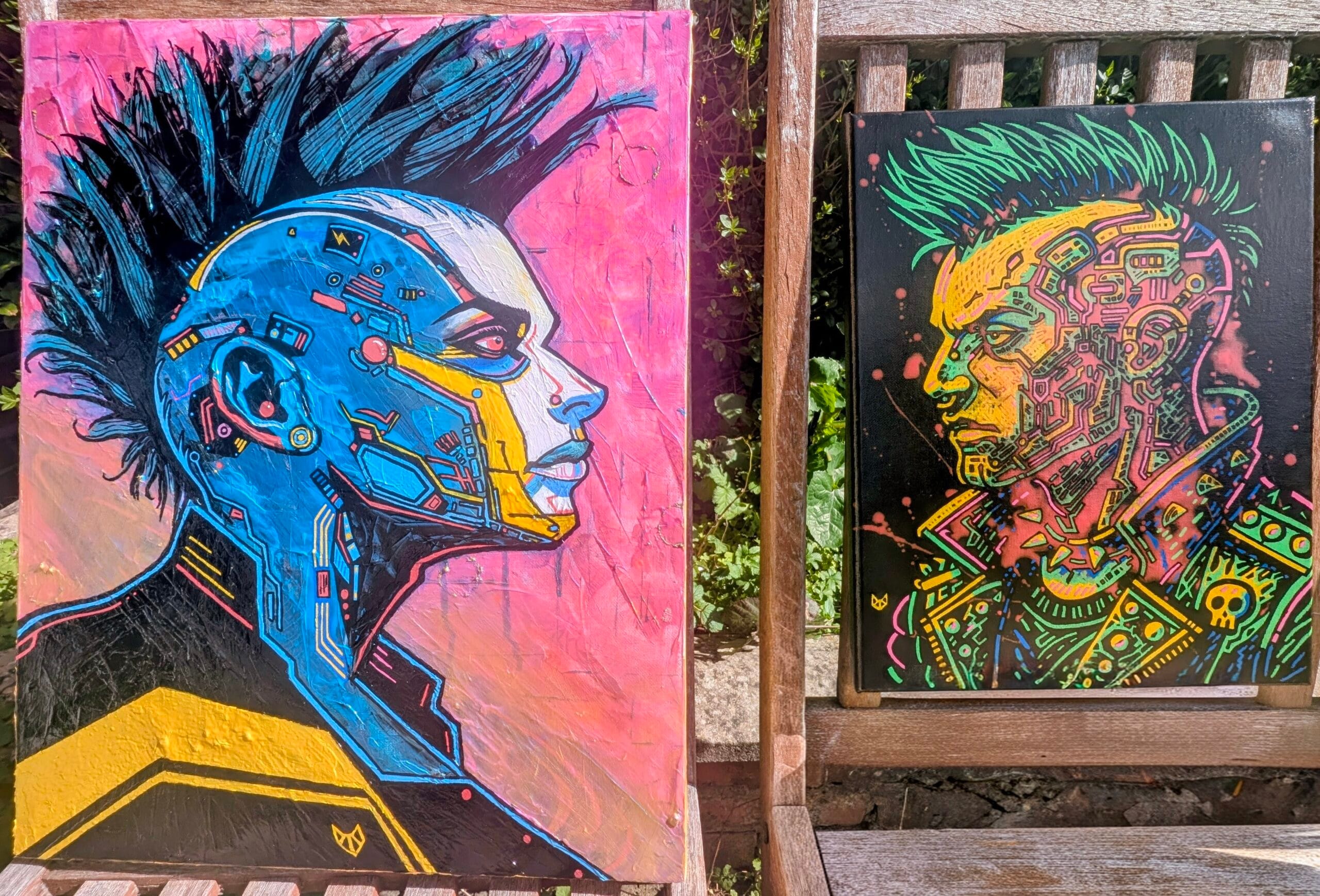
Asymmetric Diptych
Perception. What does it mean to perceive, and how does perception define our humanity? These are questions that I’ve been pondering for a long time now.
I created this diptych piece to explore the idea of altered perceptions as something both communal and individual. I deliberately used different painting styles, different canvas styles and even different techniques, as a way of showing how people might perceive each other in a future where reality itself is not fixed.
Or perhaps it is something more personal: one individual looking into a mirror and seeing not a shared reality, but the version of themselves they want to see.
How We Perceive
Humans have three kinds of vision, allowing us to see the visible light spectrum, including imaginary colours like magenta (but that’s a tale for another day). Other organisms experience the world differently. The mantis shrimp, for example, has sixteen light cones. It’s difficult to imagine just how many more colours it would be to perceive, or how different the world would appear through that kind of vision. How amazing might the world be if we could see in that way?
On The Future Of Cybernetics
With the advancement of technology and the move toward cybernetic enhancement, I think it’s fascinating to imagine a world in which human perception could expand. A world where we might see different wavelengths, such as ultraviolet or infrared, not as processed images like those from a camera and corrected into the visible spectrum, but as direct input. Light received by the eyes is passed straight to the brain as its own experience.
There may be no real way to fully understand how different that would look from what we currently expect.
A World Of Expanded Views
Going further, what if sound could also be visualised? If what we hear could take on form, revealing where it comes from, mapping space in a way similar to echolocation. How would that alter our perception of the world? What would it mean to sense someone around a corner before ever seeing them?
More importantly, how would these changes affect things like privacy and protection? If it became possible to detect people through walls or hear them before they are near, the boundaries of personal space would begin to shift.
Always Insta-Ready
Further still, how might perception be manually changed? Could reality itself be filtered in the same way an Instagram post can? Could you adjust, refine, or overlay?
At that point, would one person’s reality remain the same as another’s? What one person perceives may not ever truly match someone else’s experience. Even something as simple as the colour blue might not be the same; what one person sees as blue, another could see as green.
An Advancement For The Human Race?
It’s not all positive, though. Another form of filtering has been explored in a popular Black Mirror episode: the idea that “Undesirable” people could be “blocked” in the real world, removed entirely from perception, unable to be seen, heard, or interacted with. This raises many ethical issues. What happens to those who are “blocked”, unable to engage with others in any form?
How would that affect their mental state? And more broadly, how would society cope with the fallout of an antisocial tool such as this? Particularly with increasing pressure on mental health systems? I could probably talk about this until I’m blue in the face, but this isn’t an ethics class.
Ultimately, these are questions that will need to be addressed as technology continues to advance and as we move toward a world of increasingly altered perception.